Facundo Bacardí and his Sitges roots
Facundo Bacardí was born in Sitges and founded Bacardí in Santiago de Cuba in 1862. What is known about his life, his birthplace and his traces in town.
Published 4 min read
.jpg)
Few brands born in the Caribbean have roots as specific on the Catalan coast as Bacardí. Its founder, Facundo Bacardí Massó, was born in Sitges in the early 19th century and, like so many young men from the town, crossed the Atlantic to make a living in Cuba. This is what is known about him, and what remains unclear.
A son of Sitges in the early 1800s
Biographies agree that Facundo Bacardí was born in Sitges, but not on the date. Most place his birth in 1814, although some sources give 1813 and others, including the local tourist board, 1815. He was the son of Joan Bacardí and Marina Massó. Some biographies describe his father as a bricklayer, while others link him to the wine trade; until the parish records are published, neither version should be taken as settled.
Nor has the house where he was born been identified with certainty. The Diputació de Barcelona’s heritage inventory lists a building at carrer de Sant Pere, 22 as “Casa Bacardí” and notes, citing the historian Isabel Coll, that Joan Bacardí and Marina Massó lived on that street in 1857. But the record itself presents this as an assumption and points out that the door lintel bears the date 1864, later than that stay. So it cannot be stated that the current building is his birthplace, or even the same house the family lived in.
From Sitges to Santiago de Cuba
Facundo’s departure was not an isolated case. From the late 18th century, as trade with the Americas was opened up, many people from Sitges settled in Cuba, especially in the east of the island, and built family networks that helped younger relatives follow them. This is the story of the so-called americanos, told in Trade with the Americas and the indianos.
Facundo arrived in Santiago de Cuba as a teenager, following older brothers who were already there. Sources also disagree on the year: some say 1828, others, including the company itself, 1830. In 1843 he married Lucía Victoria Moreau, known as Amalia, from a family of French origin, and opened his own shop. The following decade was hard: the 1852 earthquake and a cholera epidemic struck Santiago and the family itself, which lost two children.
1862: a company is born
On 4 February 1862 Facundo, with capital from his brother José and a partner, bought a small distillery on the outskirts of Santiago, and the firm Bacardí, Boutellier y Compañía, the origin of the company, was formed. In the preceding years he had experimented with new distilling methods, aiming, according to the company’s own history, to produce a lighter rum than was usual at the time.
The brand’s famous bat is said to have been Amalia’s idea, inspired by the bats that roosted in the distillery. This is the version handed down by the family and the company; no contemporary document confirms it.
Facundo died in Santiago de Cuba in 1886. His sons carried on the business; one of them, Emilio Bacardí, became mayor of Santiago and was involved in the Cuban independence cause. After the 1959 revolution the company lost its facilities in Cuba and continued operating outside the island.
Traces in Sitges today
The founder’s visible links with his home town are largely recent. From 2010 the Mercat Vell, the old Modernista market hall of 1890 next to the Town Hall, housed Casa Bacardí, a visitor centre devoted to the brand’s history and to rum-making. It was not the founder’s house but a company visitor attraction. It closed in March 2021 during the pandemic restrictions, the brand left Sitges, and the building has since been put to other uses.
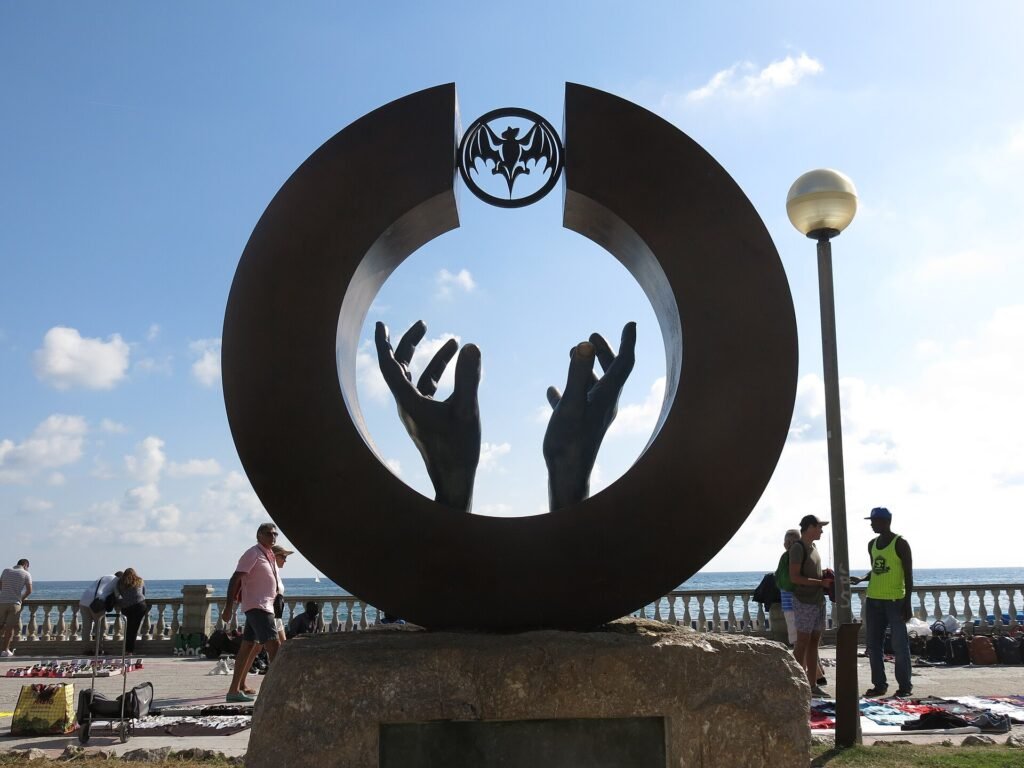
In September 2009 the company and the Town Council unveiled a sculpture by Lorenzo Quinn on the seafront promenade dedicated to Facundo Bacardí, titled Looking into the Future. There is also the privately owned building on carrer de Sant Pere, which keeps the name Casa Bacardí in the heritage inventory.
What we still don’t know
There is more storytelling than published local documentation about Facundo Bacardí. There is no agreement on the year of his birth or of his departure, his birthplace has not been securely identified, and there is no record of him ever returning to Sitges. His life, however, fits squarely into that of hundreds of people from Sitges who made their fortune, or tried to, on the other side of the Atlantic, and whose mark can still be seen in the houses of the americanos in the town centre.
Sources and further reading
- Casa Bacardí (c/ Sant Pere, 22) — Cultural Heritage Inventory, Diputació de Barcelona
- El Mercat Vell — La memòria de les cases, Sitges Town Council
- Facundo Bacardí (1815-1886) — Sitges Tourist Board (Visit Sitges)
- Statue honouring the founder unveiled in Sitges (2009) — Bacardi Limited
- The incredible story of Bacardí’s founder — Ara (in Spanish)
Keep reading
Notable figures
Miquel Utrillo and the creation of Maricel
Engineer, painter and cultural promoter: the life of Miquel Utrillo and his role as artistic director of the Maricel complex in Sitges from 1910 to 1918.
Notable figures
Santiago Rusiñol and Sitges
How Santiago Rusiñol discovered Sitges in 1891, led the Modernista Festivals from 1892 to 1899 and left his Cau Ferrat to the town when he died in 1931.
Notable figures
Ramon Casas and the Modernista artists in Sitges
Ramon Casas, the Luminist painters and the circle of musicians and writers who, alongside Rusiñol, made Sitges a centre of Catalan Modernisme.