Sitges Castle and Its Old Town Walls
From the bishops' castle to today's Town Hall: the towers, gates and surviving medieval walls of Sitges, and the artillery duel with Britain in 1797.
Published 4 min read

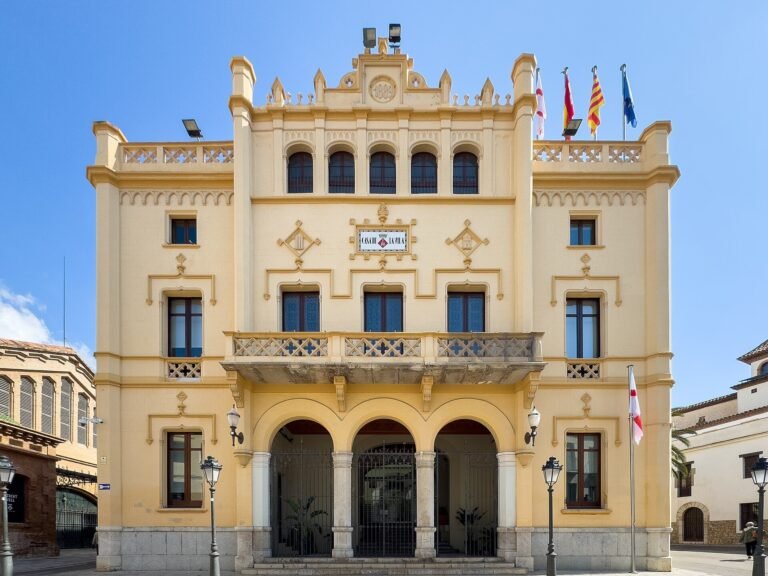
Sitges Town Hall, the Casa de la Vila, stands on the highest point of the old town, a small limestone outcrop about 17 metres high that looks straight out to sea. For almost a thousand years the spot was occupied by the town’s castle, and around it rose the walls that protected the people of Sitges from wars and corsairs. Little survives, but enough to follow its trail.
A castle of the bishops of Barcelona
The name Sitges appears in documents from the late 10th century (sources give different years, between 987 and 992). The castle is first mentioned in 1041, when Bishop Guislabert of Barcelona granted the castle of Ribes as a fief to Mir Geribert, and with it the castle of Sitges: it was a bishop’s domain. From the 12th century a family of castellans took the name of the place.
In the early 14th century the castellany passed to Bernat de Fonollar, who in 1321 obtained full jurisdiction over the territory by royal grant. In 1353, on the death of Blanca d’Asp, the castle passed to the Pia Almoina of Barcelona Cathedral, a charitable institution that remained lord of Sitges for more than four centuries. The lordship, often challenged by the townspeople, only ended in 1804, when the town was incorporated into the Crown.
From Romanesque castle to Town Hall
The building kept its Romanesque appearance until the 16th century, when it was rebuilt in late Gothic style (one stone bears the date 1525). In 1649, during the Reapers’ War (Guerra dels Segadors), Castilian troops stormed and damaged it, and it was rebuilt around 1681–1682. In 1869–1870 the State handed the site over to the town, and the old castle gave way to today’s Casa de la Vila, a neo-Gothic building by Salvador Vinyals inaugurated in 1889. Parts of the old walls were kept: Gothic arcades can still be made out on the ground floor.
Walls, towers and gates
The outcrop has been continuously inhabited since the 4th century BC, and by the 10th century it was a castrum: a tower, a small annex and a church inside a walled enclosure that was extended between the 11th and 13th centuries. According to a study published by the Museus de Sitges, the walls had the round Torre de les Hores, beside the gate facing the suburb; the tower of Sant Pere or d’en Amat, near today’s Miramar building; the Torre Verdesca, on which the Baluard now stands; and the Torre de la Vall. Two gates led out to the roads: the Portal del Pont or dels Companys to the west, and the Portal de la Davallada towards Barcelona. The exact route of the walls is still partly hypothetical.
Bernat de Fonollar strengthened and enlarged the defences, which were expensive to maintain: in 1391 the king authorised the town to levy taxes to repair them. In 2015 an excavation on Carrer Major uncovered a stretch of wall, the base of a tower and the western gate, which became the first archaeological remains in Sitges to be preserved in place. The section visible in the open air is described in the entry for the medieval wall of Sitges.
A second circuit and the defence of the coast
Outside the walls a first suburb grew up, with Carrer Nou, Tacó, Carreta, Major and de l’Aigua, and in the 17th century it was protected by a second circuit of walls with six gates. The main threat came from the sea: according to the Diputació de Barcelona’s heritage inventory, in 1685 a frigate was moored off the town to defend it against Barbary corsairs, which is where the name of the Fragata beach comes from.
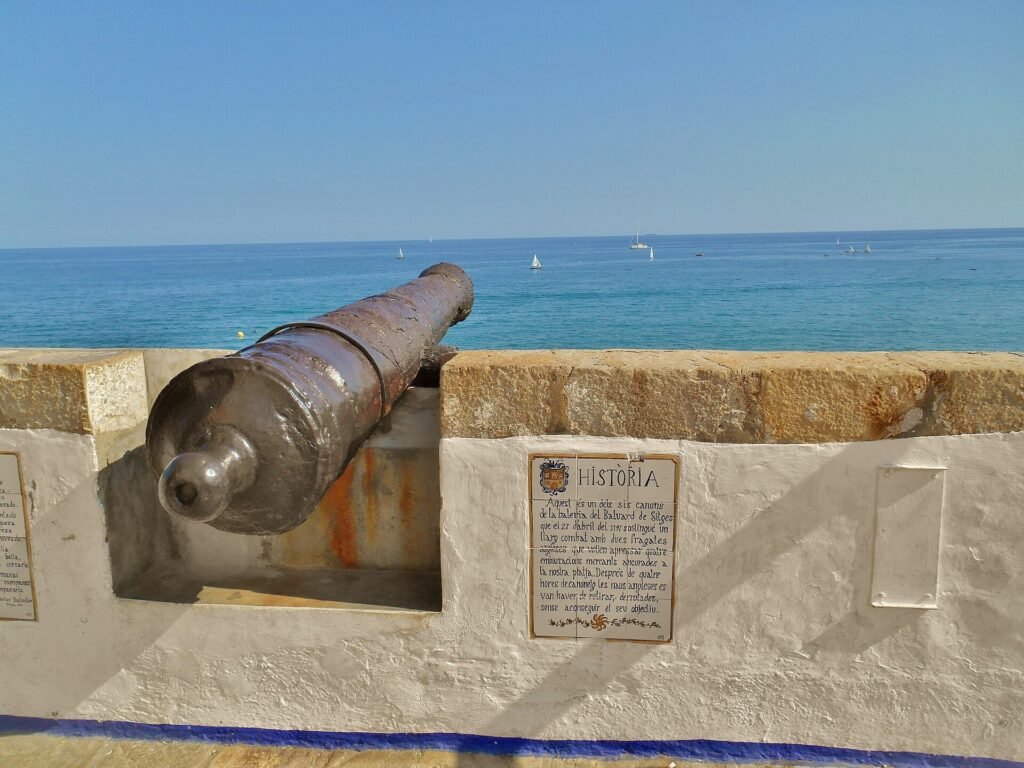
The best-remembered episode dates from 1797. With Spain at war with Britain, the castle and the Baluard battery fought an artillery duel with two British frigates that were trying to seize the merchant ships anchored off the town, until the frigates withdrew. A popular legend credits a woman named Tecla with the decisive shot; there is no documentation to support it.
What can be seen today
The most visible remains are at Plaça del Baluard and La Punta, the only section of the wall still standing: irregular rubble masonry with a sloping base and, at its foot, the old mooring bollards where boats were tied up. At the top of the steps, an 18th-century cannon points out to sea beside ceramic panels that recall those events. The history of the neighbouring church is told in another article in this section, as are the medieval origins of the town.
Castle and walls disappeared once Sitges no longer needed them, but their imprint explains why the heart of the town is still on top of the rock, looking out to sea.
Sources and further reading
- Castell de Sitges — Enciclopèdia Catalana (Catalunya Romànica)
- Sitges — Gran Enciclopèdia Catalana
- La Peça del Mes: Muralla de Sitges (August 2016) — Museus de Sitges
- Restes de la muralla. Baluard-La Punta — Heritage Inventory, Diputació de Barcelona
- Casa de la Vila de Sitges — Heritage Inventory, Diputació de Barcelona
- The Memory of our Houses: the Sitges family — Ajuntament de Sitges
Keep reading
History of Sitges
The medieval origins of Sitges
From the first 10th-century mentions to the lordship of the Pia Almoina: how the medieval town of Sitges grew up around its castle, church and walls.
History of Sitges
The first settlers of Sitges
Neanderthals in the Cova del Gegant, Neolithic farmers and Bronze Age burials: what archaeology tells us about the earliest people to live in Sitges.
History of Sitges
Sitges and Its Seafaring Tradition
Merchant ships, voyages to the Americas and the Baltic, corsairs, fishermen and the Emerencià Roig collection: the story of Sitges as a seafaring town.