The medieval origins of Sitges
From the first 10th-century mentions to the lordship of the Pia Almoina: how the medieval town of Sitges grew up around its castle, church and walls.
Published 4 min read
.jpg)
Sitges enters written history at the end of the 10th century, when its name first appears in a document. From then on, amid frontier castles, bishops, families of castellans and a Barcelona charitable institution, the small settlement on the headland known as the Punta gradually became a town.
A name on the frontier
In the 10th century the Garraf was a frontier zone between the Catalan counties and al-Andalus. The coast, exposed to Andalusi naval superiority, was an unsafe place. This is the context in which the place name appears. According to the Gran Enciclopèdia Catalana, the first mention dates from 991, in the form Cegias; Catalunya Romànica, from the same publisher, gives 987 and 992. Documents record variants such as Cigias, Ciges and Citges, usually linked to sitja, a pit dug into the ground to store grain, as we explain in where does the name Sitges come from.
The castle, between the bishop and the Ribes family
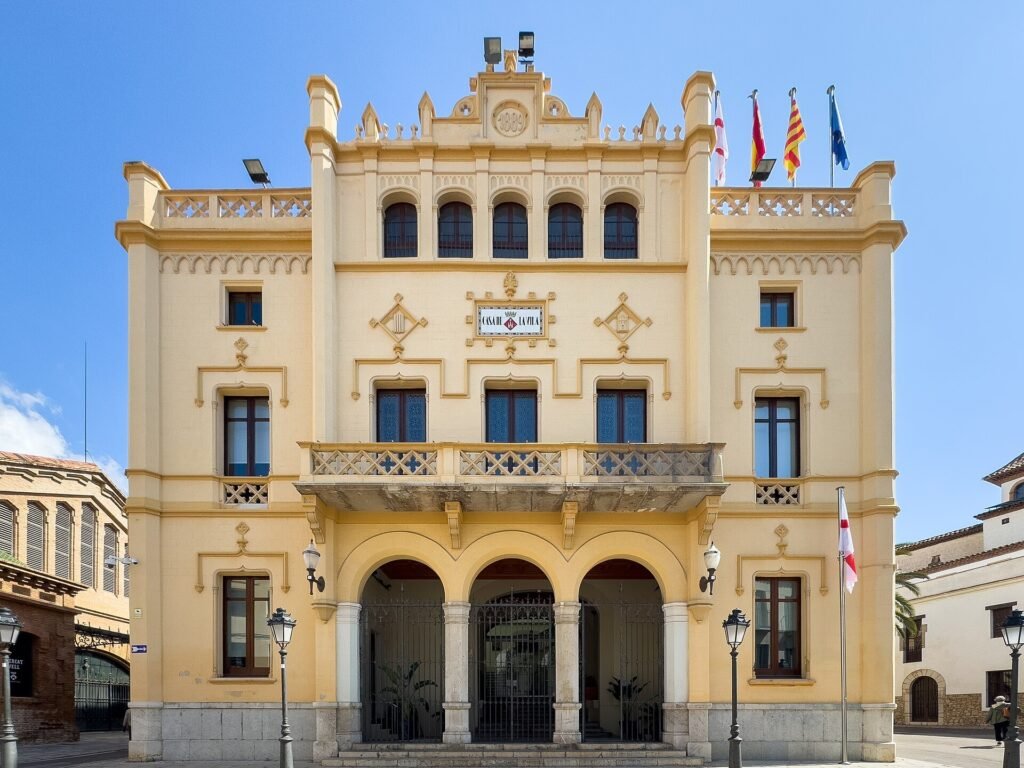
Sitges castle stood on the site of today’s Casa de la Vila (town hall) and belonged to the bishop of Barcelona. In 1041 Bishop Guislabert granted the castle of Ribes to Mir Geribert and arranged for the castle of Sitges and its lands to pass to him as well on the bishop’s death. From the late 11th century the castle was held by the Ribes, a branch of the Santmartí family, who always recognised the bishop’s overlordship: in 1130 Oleguer, archbishop of Tarragona and bishop of Barcelona, granted the castles of Sitges and Ribes as a fief to Arnau de Ribes, who swore fealty for both in 1142.
The territory had other fortified points. On the hill of Miralpeix, towards Vilanova, Bishop Guislabert granted an abandoned tower around 1057 on condition that it be rebuilt and the area resettled; the fortress was destroyed around 1190 in a feud between neighbouring lords. Up in the massif, the castle of Campdàsens is recorded in 1097.
The castellans who took the name Sitges
Guarding and running the castle fell to a family of castellans who adopted the surname Sitges. The first documented member is Guillem Arnau, mentioned in 1116. Over two centuries the family steadily extended its rights over the territory, down to Agnès de Sitges, who inherited the castellany around 1275. In the early 14th century Agnès sold her rights to Bernat de Fonollar, procurator general of Catalonia and a trusted adviser to King James II. The year varies by source: the town council gives 1306, other sources 1308.
Bernat de Fonollar and the Pia Almoina
Fonollar was far more than a buyer. In 1321 he obtained full jurisdiction over the territory by royal grant, settled in Sitges after leaving the court, and in 1324 founded the Hospital de Sant Joan Baptista. He died childless on 25 October 1326 and was buried in the parish church, where his Gothic ossuary survives, topped by a recumbent figure in chain mail. He named as his heir the Pia Almoina of Barcelona, a charitable institution attached to the cathedral.
The inheritance did not take effect at once. According to the Enciclopèdia Catalana, the castle passed to the Pia Almoina in 1353, after the death of Fonollar’s widow, and the institution had to defend its rights against other claims, including those of Bernat de Fortià and Queen Violant de Bar, before regaining full control in 1390. In 1411 it also took possession of Miralpeix, which in 1413 was incorporated into the universitat, or municipality, of Sitges. The Pia Almoina kept the lordship for more than four centuries, until the early 19th century, and for much of that time the town went to law in an effort to answer directly to the Crown.
A walled town
The medieval settlement grew on the headland around the castle and the church, which had a first Romanesque building documented in 1135 and a Gothic church completed in 1322, forerunner of today’s Sant Bartomeu i Santa Tecla. Around the 13th century a wall was built with two gates, one facing Barcelona and the other Vilanova, and the population soon spilled beyond it to form a first suburb. The castle kept its Romanesque form until the 16th century, when it was replaced by a late Gothic building, partly demolished in 1869 to make way for the Casa de la Vila. The story of these defences is told in Sitges castle and town walls.
By the end of the Middle Ages, Sitges was a town with a castle, a church, a hospital, a wall and an ecclesiastical lord. On that foundation the seafaring life, trade and wine-growing that shaped the modern town would later develop.
Sources and further reading
- Castell de Sitges — Catalunya Romànica, Enciclopèdia Catalana
- Sitges — Gran Enciclopèdia Catalana
- Castell de Miralpeix (Sitges) — Catalunya Romànica, Enciclopèdia Catalana
- El marc històric de l’art romànic al Penedès i el Garraf — Catalunya Romànica, Enciclopèdia Catalana
- Ossera de Bernat de Fonollar — Inventari del Patrimoni Cultural, Diputació de Barcelona
- La família Sitges — La memòria de les cases, Ajuntament de Sitges
Keep reading
History of Sitges
Sitges and Its Seafaring Tradition
Merchant ships, voyages to the Americas and the Baltic, corsairs, fishermen and the Emerencià Roig collection: the story of Sitges as a seafaring town.
History of Sitges
Trade with the Americas and the Return of the “Americanos”
Ships, wine and emigration to Cuba and Puerto Rico: how the 'americanos' of Sitges made their fortunes overseas and transformed the town on their return.
History of Sitges
Sitges in Roman times
The Roman villa at El Vinyet, a sarcophagus turned into a fountain and the riddle of Subur: what archaeology does and does not tell us about Roman Sitges.