The history of Sitges beaches
From fishermen's sand to the Passeig de la Ribera, sea bathing, the Terramar garden city and 20th-century breakwaters: how the beaches of Sitges changed.
Published 4 min read
.jpg)
It is hard to picture today, but for centuries the beaches of Sitges were not a place for sunbathing. They were a workplace: sand where boats were hauled up, nets were mended and goods were loaded. Turning this strip of coast into the seafront we know today was a slow process, driven by public works, private initiatives and, in the 20th century, breakwaters that changed the very shape of the shoreline.
A beach of boats and fishermen
Before tourism, the beach belonged to seafaring people. Council guides note that today’s Fragata beach was once where local fishermen hauled up their boats, and the stretch of sand beside the church, wider than it is now, was also used to keep boats. This relationship with the sea, fishing and coastal trade is explained in more detail in Sitges’ seafaring tradition.
The 19th century brought decisive changes. According to the Town Council’s historical summary, the arrival of the railway in 1881 improved links with Barcelona but hastened the final disappearance of the local fleet. At the same time, the beach landscape began to attract painters: at the end of the century, artists of the so-called Luminist School found one of their favourite subjects on the Sitges coast, and soon afterwards Santiago Rusiñol arrived.
The birth of the Passeig de la Ribera
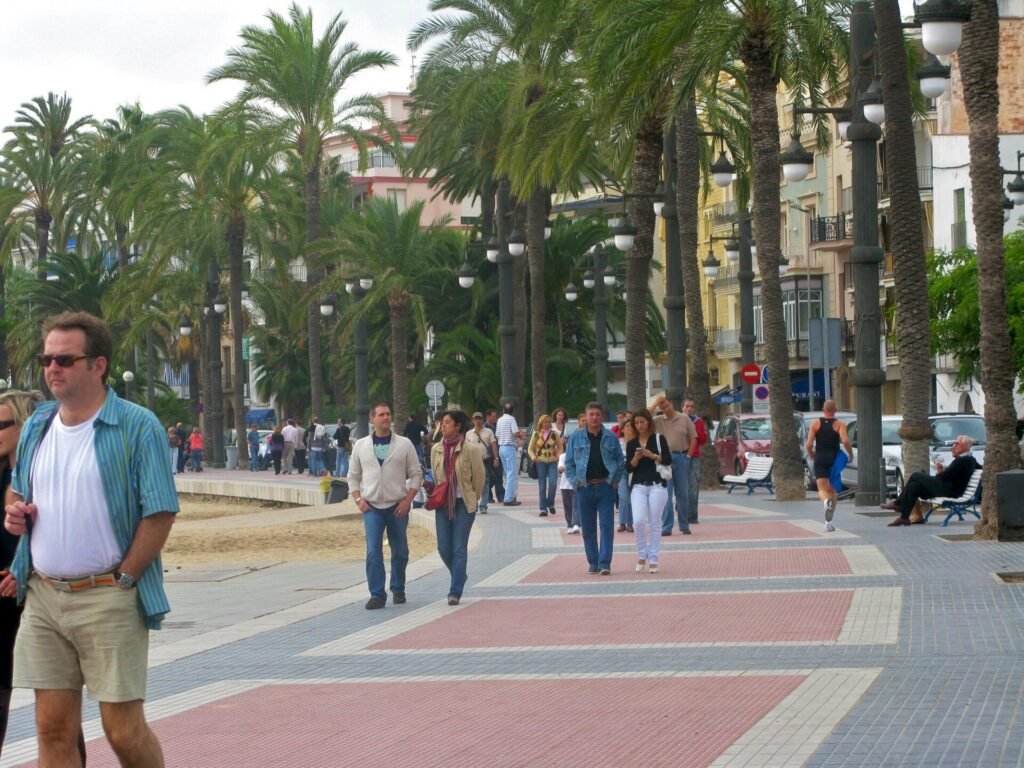
The idea of a seafront promenade is an old one. Madoz’s 19th-century gazetteer, quoted by the Enciclopèdia Catalana, already mentions a rambla built in 1829-1830 and a promenade laid out shortly before 1845. Westward growth, however, was held back by the town’s defences. According to local studies cited in research on the Sitges coastline, the fortifications in this area were demolished from 1880 onwards and the promenade was extended as far as today’s Avinguda de Sofia; in the 1890s it was lengthened westwards again.
In 1900 the flight of steps leading up from the Fragata to La Punta was completed, paid for by public subscription. Between the late 19th century and the 1920s the Passeig de la Ribera filled with summer houses, such as Casa Elvira Serra (1902-1903), and it still keeps a remarkable row of façades from that period. From La Punta to Avinguda de Sofia it is called the Passeig de la Ribera; beyond that it continues as the Passeig Marítim.
From sea bathing to summer holidays
The Town Council traces the beginning of Sitges’ tourist vocation to “the boost of sea bathing and second homes”. Barcelona families began spending the season in the town, and in 1901 the Foment Sitgetà was founded, an association the Enciclopèdia describes as a pioneer of tourist promotion. In 1916 the Hotel Subur opened, the first major milestone in local hotel history. The sources consulted do not allow the first bathing huts or bathing facilities on the beach to be dated precisely, a question that deserves research in the town’s historical archive.
Terramar, the garden city by the sea
The big leap westwards came with Terramar. The garden-city project, promoted by the Sabadell financier Francesc Armengol i Duran (1886-1931), was drawn up in 1918 and carried out, with interruptions, between 1919 and 1933. It planned streets, services, hotels, a casino and sports facilities. The Parc Hotel Terramar was built in 1919, with gardens designed by Miquel Utrillo and Josep Maria Martino as technical director. The golf club was founded in 1922, considered the second oldest in Catalonia, and the motor-racing circuit opened in 1923. After Armengol’s death, the Gran Hotel Terramar opened its doors in 1933. In the 1920s the hotel also created Anquines beach as a service area.
Breakwaters and new beaches
The present shape of the beaches is largely a 20th-century creation. Storms in the 1940s forced a rebuilding of the Ribera: the promenade was raised and the first breakwaters were built. More works followed from the 1950s: the Ribera beach, as it is defined today, was created in 1959, the Bassa Rodona beach in 1968, and by around 1975 there were nine breakwaters along two kilometres of coast. These works greatly enlarged the area of sand. The promenade was also remodelled in 1965.
The result is today’s seafront, with beaches set between breakwaters, described in our guide to Sitges beaches. Beneath the sand and the promenade, though, the traces of that coast of boats and nets remain.
Sources and further reading
- Sitges — Enciclopèdia Catalana
- Una mica d’història — Ajuntament de Sitges
- Peça del mes (June 2019): Jardins de Terramar — Museus de Sitges
- Parc de Terramar. Jardins de l’Hotel Terramar — Cultural Heritage Inventory, Diputació de Barcelona
- Mario Vilar Ramírez, Les platges de Sitges (secondary-school research project) — Col·legi de Geòlegs de Catalunya
Keep reading
Sitges curiosities
Malvasia de Sitges: the story of a wine and a bequest
The origins, heyday and crisis of Malvasia de Sitges, the Llopis bequest to the Hospital de Sant Joan Baptista and the Malvasia Interpretation Centre.

Sitges curiosities
Sitges as a film location
From the birth of the Sitges Film Festival in 1968 to documented shoots in town, from Decameron Nights to Who Can Kill a Child? and recent TV series.
Sitges curiosities
Where does the name Sitges come from?
Sitges is the plural of Catalan 'sitja': grain silos or pits in the rock. Its first 10th-century mentions, medieval spellings and Coromines' views.