Where does the name Sitges come from?
Sitges is the plural of Catalan 'sitja': grain silos or pits in the rock. Its first 10th-century mentions, medieval spellings and Coromines' views.
Published 4 min read
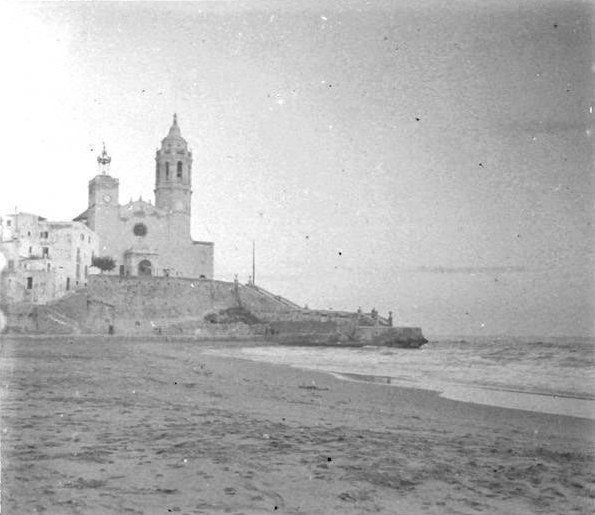

Few Catalan place names look as transparent as Sitges. Any Catalan speaker recognises it as the plural of sitja, a word that still means a pit dug into the ground to store grain. But a recognisable word does not mean a simple story: behind the name lie medieval documents with shifting spellings, a debate about what kind of sitges gave the place its name, and an etymology of the word itself that linguists still regard as obscure.
The first written mentions
The name first appears in documents from the end of the 10th century, although sources disagree on the exact year. The Enciclopèdia Catalana dates the first mention to 991, in the Latinised form Cegias; the historical summary published by Sitges Town Council gives 990, when “the place called les Sitges is already mentioned”, and other publications give 992. The difference probably comes down to how the documents have been dated or read, so the safest statement is that the name was in use in the last years of the 10th century.
The castle appears shortly afterwards, mentioned in 1041 according to the Enciclopèdia (some publications cite 1047), and with it a series of spelling variants: Cigias around 1078 and later Ciges, Cigas or Citges. Such variation was common among medieval scribes, who were adapting a spoken word to Latin. The castle, which stood where the Casa de la Vila (town hall) is today, was the core around which the town grew, as explained in the medieval origins of Sitges.
First hypothesis: grain silos
The most widespread explanation, given by the Town Council and Sitges Tourism, is that the place took its name from the underground silos where cereals were stored. Sitges were pits dug into earth or rock, with a narrow mouth and a wider body, that kept grain for months. They were used from prehistory to the Middle Ages and are common at Iberian sites throughout Catalonia.
The council’s historical summary links the name specifically to the Iberian and Roman-era silos documented at the site. In an interview published by Museus de Sitges in 2013, archaeologist Pere Izquierdo also recalled that the headland of the church has been a known archaeological site since the 19th century, and pointed to the possible existence of ancient silos now under water off Sant Sebastià beach. If this hypothesis is right, the place name is a kind of description of the landscape: “the place of the silos”.
Second hypothesis: pits and hollows
Joan Coromines, author of the Diccionari etimològic i complementari de la llengua catalana and the Onomasticon Cataloniae, refined the older meaning of the word. In his analysis, sitja (earlier cija) mainly meant a pit or hole, whether artificial, even a dungeon, or natural, such as a small sinkhole. In place names, derivatives such as sitjar often refer to ground full of cracks or cavities rather than to grain stores.
For this reason some authors suggest that “Sitges” could refer to the pits, sinkholes or gullies of the limestone terrain of the Garraf, not necessarily to man-made silos. The two readings are not mutually exclusive: either way, the name describes hollows in the ground. What cannot be stated with certainty is which meaning those who named the place had in mind.
A word of uncertain origin
There is one more layer of uncertainty: the origin of the word sitja itself. In his etymological dictionary, Coromines reviews earlier proposals: some scholars considered it of unknown origin, others suggested a pre-Roman, Iberian root, and another proposed an Arabic origin meaning “prison”, a theory Coromines rejects. The debate is philological and concerns the whole Catalan language, not just Sitges, but it shows that even the most transparent names have roots that are hard to trace.
All of this should be kept apart from another tradition, the one that identifies Sitges with the Roman town of Subur. That concerns the ancient history of the place rather than the etymology of its name, and we look at it in Why is Sitges called the “Blanca Subur”?.
What we know and what we don’t
In short, there is agreement that Sitges is the plural of sitja and that the name was already in use at the end of the 10th century. It very probably refers to the grain silos that have left archaeological traces at the site, although the broader sense of a natural pit or hollow cannot be ruled out. Beyond that, any further detail would be speculation. Anyone who wants to see the landscape behind the name can start at the church headland and the old town, where the written history of Sitges begins.
Sources and further reading
- Sitges — Enciclopèdia Catalana (Gran Enciclopèdia Catalana)
- Una mica d’història — Ajuntament de Sitges
- Entry “sitja”, Diccionari etimològic i complementari de la llengua catalana (Joan Coromines) — Institut d’Estudis Catalans
- Rosa M. Anglès, “L’aspecte del terreny i l’onomàstica de l’Espluga Calba”, Onomàstica 7 (2021) — Societat d’Onomàstica / RACO
- Pere Izquierdo: “En Sitges, los romanos tenían puerto, ciudad y comerciantes” — Museus de Sitges
Keep reading
Sitges curiosities
The history of Sitges beaches
From fishermen's sand to the Passeig de la Ribera, sea bathing, the Terramar garden city and 20th-century breakwaters: how the beaches of Sitges changed.
Sitges curiosities
Malvasia de Sitges: the story of a wine and a bequest
The origins, heyday and crisis of Malvasia de Sitges, the Llopis bequest to the Hospital de Sant Joan Baptista and the Malvasia Interpretation Centre.
Sitges curiosities
How Sitges became an international tourist destination
From the railway and Barcelona's summer visitors to Terramar, the 1960s boom and LGBTQ+ tourism: how Sitges became an international destination.