Sitges in Roman times
The Roman villa at El Vinyet, a sarcophagus turned into a fountain and the riddle of Subur: what archaeology does and does not tell us about Roman Sitges.
Published 4 min read
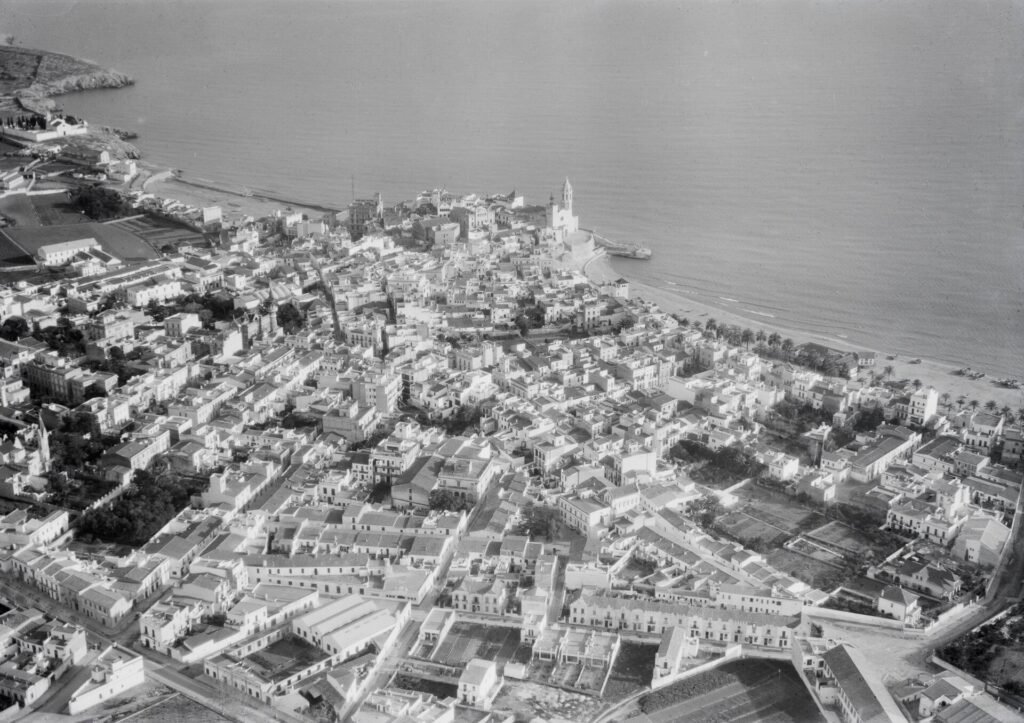
Tradition has often linked Sitges with Rome, starting with the town’s nickname, «Blanca Subur». But what does archaeology actually say? Rather more than people tend to think, though not always what the legend would like: the municipality has the remains of a farming villa, grain silos, amphorae, a sarcophagus and a few remarkable objects, but no Roman town has ever been found.
Before Rome: a well-connected Iberian territory
When the Romans landed in the north-east of the Iberian Peninsula at the end of the 3rd century BC, the Garraf coast was already home to Iberian communities. On the Puig de Sitges, the headland of the old town, silos containing material from the 4th and 3rd centuries BC have been excavated, and sites such as the Pujol d’en Pei (Montseva) have produced Italic, Punic-Ebusitan and Massaliote amphorae that point to busy seaborne trade. According to the Museus de Sitges, goods imported from the central and eastern Mediterranean found in the old-town silos suggest a harbour with commercial traffic. Romanisation was gradual: many of these places stayed in use through the 2nd and 1st centuries BC, by then under Roman rule.
The villa at El Vinyet
The most important Roman site in Sitges lies around the Ermita del Vinyet. Archaeologists have recorded a villa there, meaning a working farm with a residence, covering about 3,000 m² with some thirty rooms arranged around three or four courtyards. It had drains, around twenty silos and, in some rooms, mosaic floors and multicoloured wall paintings, of which fragments survive. Its business was producing and selling wine, olive oil and cereals.
Occupation of the site may go back to the Iberian period, but the villa is documented from the late 1st century BC and lasted until the 5th century AD, perhaps even the 6th. The first excavations, in 1948 and 1952, uncovered a drain, what may be a stretch of road and a small late Roman cemetery. The largest campaign took place in 2003-2004 under Joan M. García Targa. Finds include large amounts of pottery from North Africa, Gaul, Italy and southern Iberia, bone needles, bronze coins, millstone fragments and a piece of marble slab inscribed «C.CAECILIUS». The remains have since been covered with earth to protect them and cannot be visited.
A sarcophagus turned into a fountain
The most visible Roman object in Sitges comes from this same area: a sarcophagus of local stone decorated with vertical fluting, found in the second half of the 19th century in unknown circumstances. It dates from the 3rd or early 4th century AD and resembles those of the Early Christian cemetery in Tarragona. For a long time it served as an animal trough; today it is the basin of a fountain at the Racó de la Calma on Carrer de Fonollar, where anyone can see it.
More traces around the municipality
El Vinyet is not an isolated case. Two coins of the emperor Tiberius were found on the Puig de Sitges in the 19th century, and building work around the town hall has exposed silos with Iberian and Roman material; it has been suggested that there was also a villa-type settlement there, though none has been located. At Les Forques, near the Aiguadolç marina, the base of a lacus came to light, a tank lined with opus signinum that was probably used for wine-making. Other spots, such as Can Girona near Miralpeix, the Serra dels Paranys and Santa Margarida on the Terramar golf course, are known only from pottery picked up on the surface. The Museus de Sitges highlight a 1st-century gold ring, known as the «Subur ring», possibly of British or northern European origin.
Was Sitges the Roman Subur?
Classical writers such as Pliny the Elder, Pomponius Mela and Ptolemy mention a settlement called Subur on this stretch of coast. Its identification with Sitges is long-standing and explains the nickname «Blanca Subur», which we look at in why is Sitges called Blanca Subur. But its exact location is unknown. The Gran Enciclopèdia Catalana notes that the remains found on the headland do not prove it stood here, and the Museus de Sitges point out that some specialists have questioned the link, though it has never been ruled out. The safest statement is that Sitges is one of the candidates, not that it was Subur.
What does seem clear is that in Roman times the land around Sitges was a rural landscape of villas and fields open to the sea. Of what happened next, between the end of the Empire and the first appearance of the place name in written records, there is very little archaeological evidence; the story continues in the medieval origins of Sitges.
Sources and further reading
- El Vinyet (vil·la romana) — Inventari del Patrimoni Cultural, Diputació de Barcelona
- Sarcòfag del Racó de la Calma — Inventari del Patrimoni Cultural, Diputació de Barcelona
- El Puig de Sitges — Inventari del Patrimoni Cultural, Diputació de Barcelona
- Les Forques — Inventari del Patrimoni Cultural, Diputació de Barcelona
- The Archaeological Collection — Museus de Sitges
- Sitges — Gran Enciclopèdia Catalana
Keep reading
History of Sitges
Sitges Castle and Its Old Town Walls
From the bishops' castle to today's Town Hall: the towers, gates and surviving medieval walls of Sitges, and the artillery duel with Britain in 1797.
History of Sitges
The first settlers of Sitges
Neanderthals in the Cova del Gegant, Neolithic farmers and Bronze Age burials: what archaeology tells us about the earliest people to live in Sitges.
History of Sitges
Trade with the Americas and the Return of the “Americanos”
Ships, wine and emigration to Cuba and Puerto Rico: how the 'americanos' of Sitges made their fortunes overseas and transformed the town on their return.