Malvasia de Sitges: the story of a wine and a bequest
The origins, heyday and crisis of Malvasia de Sitges, the Llopis bequest to the Hospital de Sant Joan Baptista and the Malvasia Interpretation Centre.
Published 4 min read
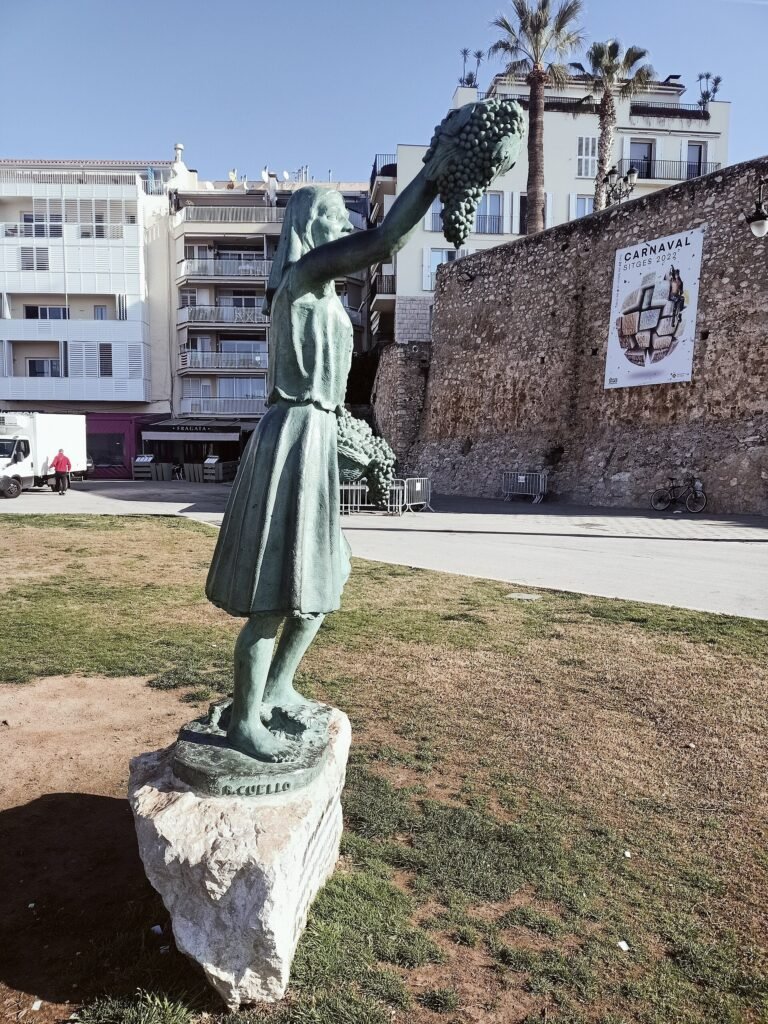

In the square in front of the Hospital de Sant Joan Baptista Malvasia vines still grow. There are only a few, but they carry centuries of history: that of Malvasia de Sitges, a sweet wine that made the town known, came close to disappearing and survived thanks to a will and a charitable institution. Its story is also the story of Sitges.
An origin between legend and documents
Malvasia is a family of grape varieties from the eastern Mediterranean, linked since the Middle Ages to the trade in Greek wines. How it reached Sitges is not documented. A widely repeated tradition says it was brought by Almogavars or soldiers returning from the eastern Mediterranean in the early 14th century; it is an appealing story, but no document confirms it.
What is documented is its long presence in the area. Oenologist Enric Bartra, of the Catalan Institute of Vine and Wine, notes references from the 15th century, and the Diputació de Barcelona’s heritage inventory considers that its cultivation in Sitges may date back to the early modern period.
Centuries of splendour: vineyards, cellars and trade
Between the 18th and 19th centuries Malvasia was the most prized wine in the municipality. According to figures presented by the Arxiu Històric de Sitges in 2022, in 1716 the town had some 300 hectares of vineyards, 90 of them Malvasia, and the variety drove much of its foreign trade. Bartra, by contrast, puts its maximum extent at about 150 jornals, roughly 50 hectares, in areas such as Aiguadolç, Els Gassons and around the Vinyet; the figures do not match and are best read as estimates.
A recent find illustrates that trade. In 2022 the Arxiu Històric presented a Malvasia de Sitges label dated 1811, considered the oldest known label of a Catalan wine. It belongs to the Can Falç collection: Ramon de Dalmau i Falç had moved to Mallorca in 1809 to escape the Napoleonic war and sold his family’s Malvasia there.
Powdery mildew, phylloxera and decline
The 19th century also brought disease. Malvasia is highly sensitive to powdery mildew, and the outbreaks of 1855 and 1865 greatly reduced its area. Phylloxera arrived at the end of the century, around 1890 in the Penedès, forcing growers to replant on American rootstocks. Replanting favoured more productive, resistant varieties; low-yielding and labour-intensive Malvasia lost ground.
The first Catalan Wine Statute (1932) protected it as a designation of origin, but the decline continued through the 20th century, as Sitges turned towards commerce and tourism and building pressure swallowed old vineyards. According to the Arxiu Històric, by around 1980 only about three hectares remained.
The Llopis bequest and the Hospital de Sant Joan Baptista
Its survival is largely owed to Manuel Llopis i de Casades (1885–1935), a diplomat and the last heir of the Llopis family, one of the oldest in Sitges and owners of the house that is now the Museu Romàntic Can Llopis. In his will he left his Malvasia vineyards and winemaking equipment to the Hospital de Sant Joan Baptista, on condition that the wine continue to be made according to family tradition.
The hospital, founded by Bernat de Fonollar in the first half of the 14th century (sources give 1323 or 1324) and moved in 1912 to its present modernista building, whose story is told in the old Hospital of Sant Joan, has kept up production ever since. Today its foundation runs the Celler de l’Hospital, and the income supports its care work with older people. The Diputació inventory notes that its urban vineyards are the only Malvasia vines preserved in the town of Sitges.
The Malvasia Interpretation Centre and the revival
On 13 April 2019 the foundation opened the Centre d’Interpretació de la Malvasia (CIM) in the former Corral de la Vila, an 18th-century building, and the hospital’s old cellar, on Plaça Joan Duran i Ferret.
The revival is real: according to the organisers of the Setmana de la Malvasia, in 2025 some 125 hectares were registered, mainly in the Penedès and the Garraf massif, and the number of wineries making single-varietal Malvasia has grown over the past decade.
Tasting it in a winery or in one of the town’s places to eat and drink is also a way of understanding how a private bequest became shared heritage.
Sources and further reading
- La malvasia de Sitges en el món de les malvasies — Enric Bartra, Dossiers Agraris ICEA (2006)
- L’etiqueta més antiga d’un vi català és la d’una malvasia de Sitges de 1811 — 3Cat / ACN (2022)
- Les vinyes de Malvasia de l’hospital de Sant Joan, Sitges — Cultural Heritage Inventory, Diputació de Barcelona
- Manuel Llopis i Casades (1885-1935) — Sitges Tourism
- CIM · Malvasia de Sitges Interpretation Centre — Penedès Turisme
Keep reading
Sitges curiosities
How Sitges became an international tourist destination
From the railway and Barcelona's summer visitors to Terramar, the 1960s boom and LGBTQ+ tourism: how Sitges became an international destination.

Sitges curiosities
Sitges as a film location
From the birth of the Sitges Film Festival in 1968 to documented shoots in town, from Decameron Nights to Who Can Kill a Child? and recent TV series.
Sitges curiosities
Where does the name Sitges come from?
Sitges is the plural of Catalan 'sitja': grain silos or pits in the rock. Its first 10th-century mentions, medieval spellings and Coromines' views.