The Cau Ferrat and Santiago Rusiñol
From the studio Rusiñol built from two fishermen's houses in 1893–1894 to the museum opened in 1933 and restored in 2010–2014: the Cau Ferrat's story.
Published 4 min read
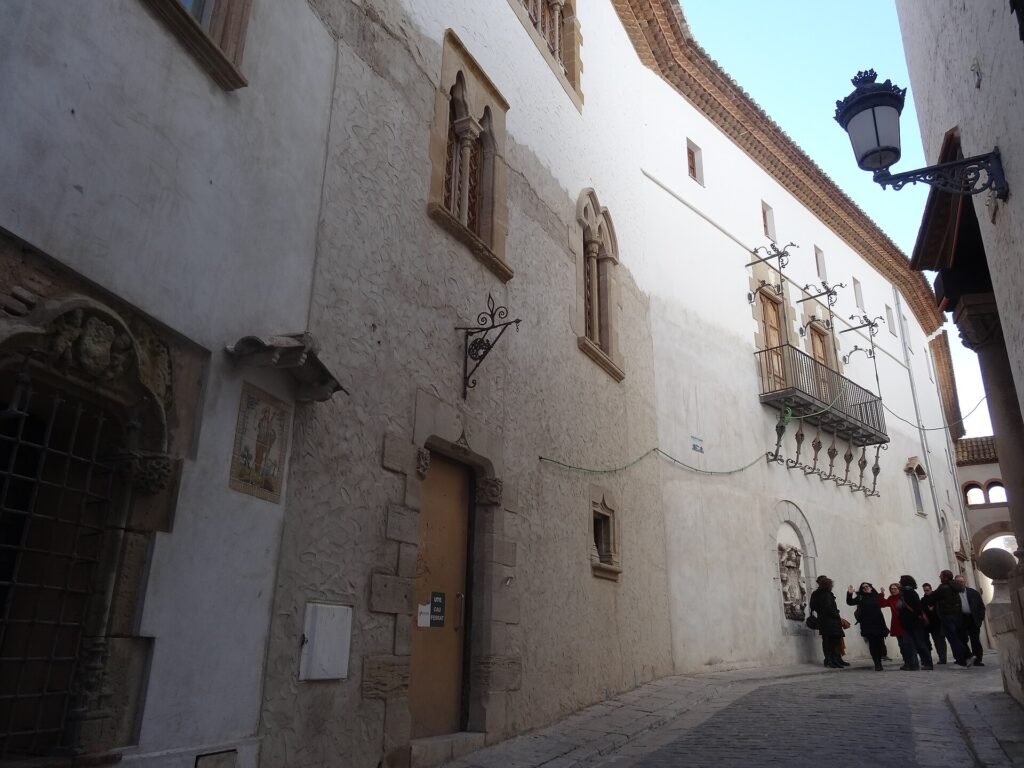

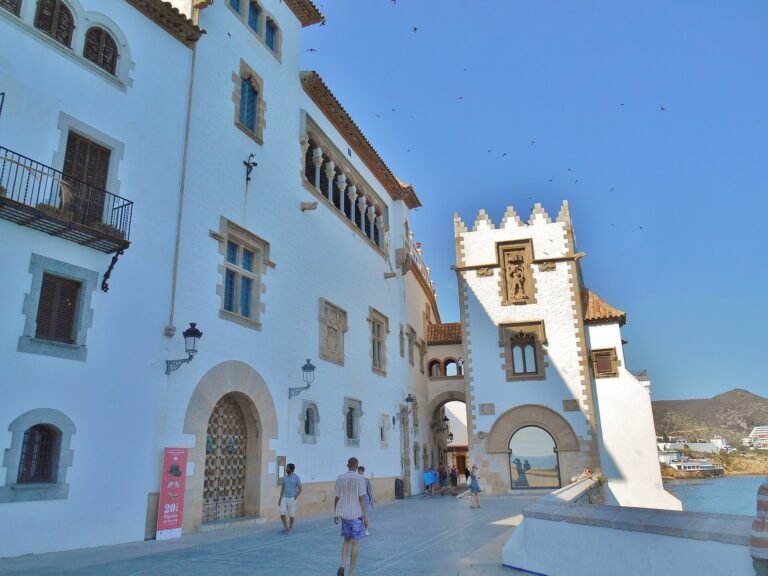
At the edge of the old town, on the rocks and a few steps from the church, stands a white house with Gothic windows looking straight out over the Mediterranean. This is the Cau Ferrat, the home and studio Santiago Rusiñol created out of two fishermen’s houses and which, after his death, became one of the first museums in Sitges. Its story is that of a building that went from artists’ refuge to public museum, with all the changes that involved.
From two fishermen’s houses to a home and studio
The building began as two modest houses by the sea, known as can Falua and can Sensa. According to the Museus de Sitges, Rusiñol bought the first in July 1893 and in May 1894 acquired the one next door, while applying to the Town Council for permission to enlarge it with a design by the architect Francesc Rogent i Pedrosa. The work was finished in the summer of 1894, and the Cau Ferrat was officially inaugurated on 4 November that year, during the third Festa Modernista, whose story is told in the article on Santiago Rusiñol and Sitges.
The result is an eclectic two-storey building mixing Gothic, historicist, Modernista and vernacular elements. Gothic windows from the old Sitges castle, demolished to build the present town hall, were reused in the whitewashed façade. On the seaward side a small cylindrical turret stands out.
A name and its spaces
The name sums up its creator’s intention: in Catalan cau means a den or hideaway, and ferrat refers to iron, after the collection of wrought ironwork Rusiñol had gathered on his travels around Catalonia, which he first kept in a studio in Barcelona shared with the sculptor Enric Clarasó.
Inside, the great hall on the first floor has a neo-Gothic feel, with pointed arches, a gallery with stained glass and a coffered wooden ceiling. One of the rooms, the so-called cambra del brollador (fountain room), holds a fifteenth-century Gothic fountain from the sanctuary of the Ermita del Vinyet.
The collections
Rusiñol kept filling the house with objects until it became a museum-studio. The Gran Enciclopèdia Catalana and the Museus de Sitges highlight:
- The collection of Catalan and Castilian wrought iron, with pieces from the thirteenth to the twentieth centuries, which gave the building its name.
- Two paintings by El Greco, The Repentant Saint Peter (Sant Pere penitent) and The Tears of the Magdalene (Les llàgrimes de la Magdalena), bought in Paris in 1894.
- The collection of Catalan glass from the sixteenth to the twentieth centuries, bought from the painter Alexandre de Riquer in 1902, along with ceramics, furniture and polychrome carvings from the fifteenth to the eighteenth centuries.
- Archaeological material, including Punic pieces from the Puig des Molins excavations in Eivissa (Ibiza) and Greek pottery.
- Modern art: works by Rusiñol himself and by artists in his circle, such as Ramon Casas, Picasso, Ramon Pichot, Isidre Nonell, Ignacio Zuloaga and Darío de Regoyos, and sculptures by Enric Clarasó, Manolo Hugué and Pau Gargallo.
From the 1931 bequest to a public museum
Rusiñol died in 1931 and in his will left the Cau Ferrat and its collections to the town of Sitges. According to the Diputació de Barcelona heritage inventory, the Town Council received the bequest from his family on 13 December 1932, and the museum opened to the public in April 1933. That year a board of trustees was set up, and the first director, the art historian Joaquim Folch i Torres, took charge of arranging the displays and inventorying the holdings.
Under Franco the museum went through a period of stagnation. In 1962 the building was declared a monument, today a Cultural Asset of National Interest (BCIN); in 1966 major work was carried out to address its poor condition, and in 1968 the Diputació de Barcelona took over its management. Since 1994 it has been run by the Consorci del Patrimoni de Sitges.
The 2010–2014 restoration
Direct contact with the sea took its toll on the building. Between 2010 and 2014 it underwent a thorough rehabilitation, led by the architect Josep-Emili Hernàndez-Cros, which dealt with damp, restored tiles and decorative features and gave the museum modern facilities. The Museu del Cau Ferrat reopened in December 2014 and today forms a single complex with the Museu de Maricel, linked by the Can Rocamora building.
Walking through its rooms reveals, beyond the works themselves, the house as its creator imagined it: a place to live, paint and welcome friends by the sea.
Sources and further reading
- El Cau Ferrat — Gran Enciclopèdia Catalana
- The building (Cau Ferrat) — Museus de Sitges
- Cau Ferrat (inventory record) — Diputació de Barcelona, Cultural Heritage Inventory
- Cau Ferrat Museum — Patrimoni Cultural, Generalitat de Catalunya
Keep reading
Historic buildings
Sant Sebastià cemetery and its artistic heritage
History of Sitges' Sant Sebastià cemetery: blessed in 1814, with Francesc Cros's gateway, tombs by Llimona and Rogent and the artists buried there.
Historic buildings
The Hospital de Sant Joan Baptista: from medieval hospital to Modernista building
From Bernat de Fonollar's medieval hospital, sold to Deering to build Maricel, to the Modernista building by Font i Gumà that opened in 1912.
Historic buildings
The Palau de Maricel and its construction
From the medieval Hospital of Sant Joan to Charles Deering's home: how Maricel was built between 1910 and 1918, its halls and its uses up to the museum.