Sitges and Its Seafaring Tradition
Merchant ships, voyages to the Americas and the Baltic, corsairs, fishermen and the Emerencià Roig collection: the story of Sitges as a seafaring town.
Published 4 min read
_-_4.jpg)
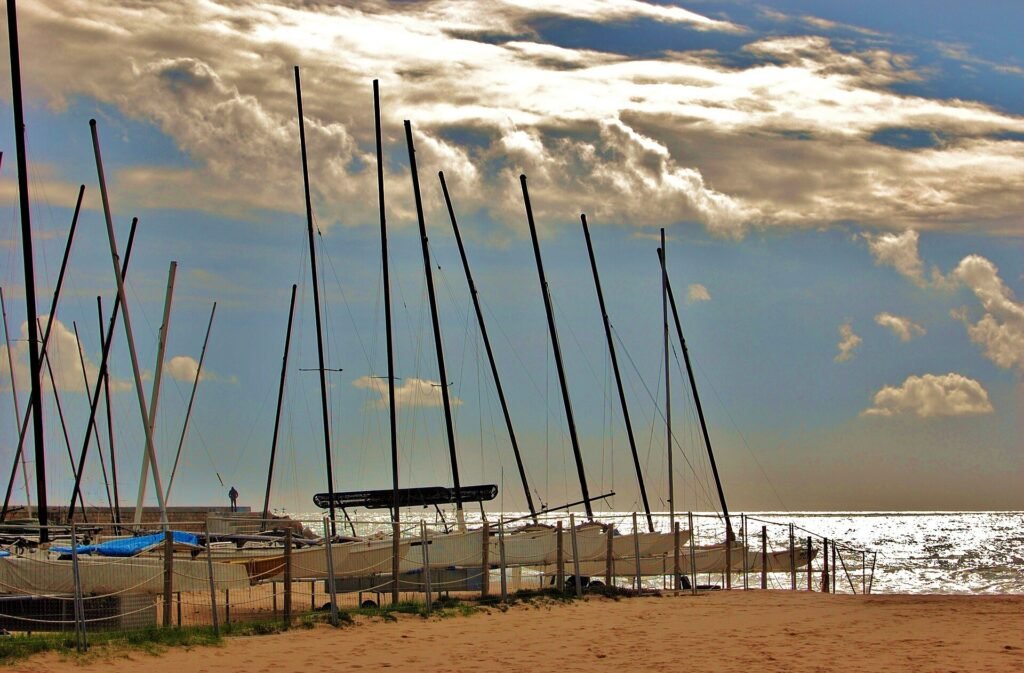
Today we associate the sea at Sitges with beaches and the seafront promenade, but for centuries it was above all a place of work. Fishermen, sailors, skippers and merchants made their living from it, and Penedès wine and Malvasia left by sea for other ports. That seafaring vocation explains much of the town’s history, from its prosperity in the 18th century to its ties with the Americas.
A town facing the Mediterranean
In the Middle Ages, according to the Town Council’s historical overview, Sitges was the only coastal town between Barcelona and Tarragona, and its people combined farming with winemaking and Mediterranean sea trade. Its wines, white and red and above all Muscat and Malvasia, were sold abroad from an early date. Tradition holds that Malvasia was brought by expedition members returning from Greece in the early 14th century, but this is a legend with no documentary confirmation.
From coastal trade to ocean routes
From the 16th century, despite plague, war and piracy, the Sitges economy turned to exporting wine to northern Europe, and the town’s own merchant fleet employed a large part of the population. Coastal trade was followed by deep-sea voyages.
Figures compiled by the historian Llopis i Bofill, quoted in the Gran Enciclopèdia Catalana, show how far it reached: between 1755 and 1799, 52 Sitges ships made 13 voyages to Buenos Aires, 105 to the Windward Islands and 41 to Tierra Firme and the Gulf of Mexico. The same author records 46 Sitges captains who sailed the coasts of the Algarve, Cantabria and northern Europe, as far as Saint Petersburg. This maritime network lies behind Sitges’ trade with the Americas and its “americanos”.
Defending the town from the sea
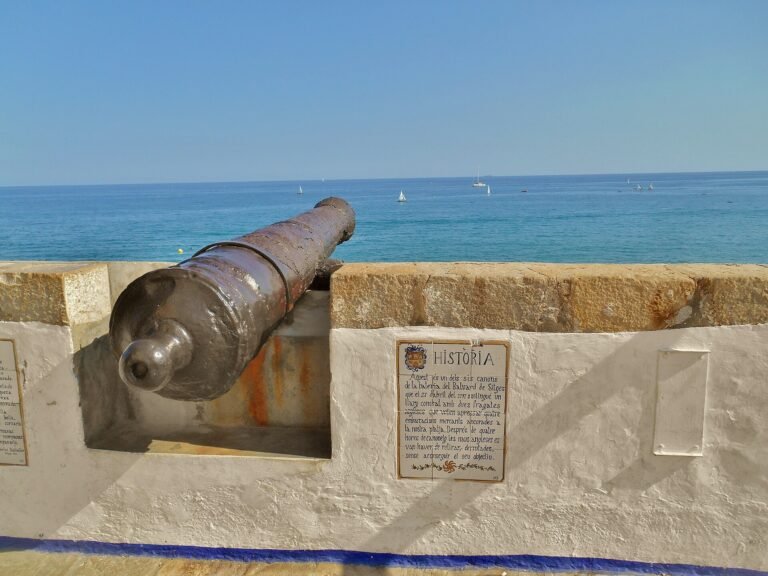
The sea also brought danger. Raids by North African corsairs left their mark on place names — the Cala Morisca — and on the town’s defences. According to the Diputació de Barcelona’s heritage inventory, in 1685 a frigate was moored off the town to defend it against Barbary pirates, crewed by men from the guild of Sant Elm; the Fragata beach takes its name from it. At the base of the Baluard you can still see the 16th-century stone bollards where boats were tied up, and in 1797 the Baluard’s cannons drove off two British frigates trying to seize the merchant ships at anchor. We tell the story in more detail in the article on the castle and town walls.
Fishermen, brotherhoods and processions
Alongside the merchant navy there was fishing, more modest but constant. The Germandat de Pescadors i Mariners (Brotherhood of Fishermen and Sailors) celebrated the feast of the Mare de Déu del Carme on 16 July: after lunch, families and sailors went down to the beach, crowded with decorated boats, and the image of the Virgin led the procession of boats. The custom lives on: today the Confraria de Pescadors de Sitges takes the image out to sea in a procession from the Aiguadolç marina towards Terramar, laying a floral offering off the cemetery in memory of fishermen and sailors who have died. Check the dates in the what’s on listings and read more in our article on seafaring festivals.
Fishing, however, has lost ground. The Gran Enciclopèdia notes a sharp decline in the 1990s, although the fishermen’s association is still active, and recalls that the old fishermen’s quarter of Cases Noves was built over in the 1950s.
The end of an era and the legacy of Emerencià Roig
The Sitges fleet went into decline in the 19th century. The arrival of the railway in 1881 improved communications, but transatlantic traffic became concentrated in the port of Barcelona; around 1900, phylloxera and the loss of Spain’s last colonies further reduced shipping.
Much of what we know about that world we owe to Emerencià Roig i Raventós (Sitges, 1881–1935), son of the painter Joan Roig i Soler. A pharmacist by training, he devoted his last years to documenting Catalan seafaring life, talking to captains, pilots and fishermen. He published La pesca a Catalunya (1926), La marina catalana del vuit-cents (1929) and Sitges dels nostres avis (1934). After his death, his brother Josep donated his collection to the Town Council: some 350 objects, including more than sixty ship models, navigation instruments, nautical charts and drawings. It opened to the public in 1936 at the Palau de Maricel, regarded as the first maritime museum in Catalonia, and between 1995 and 2010 it was displayed at the Museu de Maricel.
That collection and the Baluard bollards recall a Sitges that lived from the sea long before the sea became a tourist attraction.
Sources and further reading
- Sitges — Gran Enciclopèdia Catalana
- Una mica d’història — Ajuntament de Sitges
- Norais del Baluard — Heritage Inventory, Diputació de Barcelona
- Diada dels pescadors i mariners, Mare de Déu del Carme — Heritage Inventory, Diputació de Barcelona
- Maritime Collection Emerencià Roig i Raventós — Museus de Sitges
- Emerencià Roig i Raventós — Argo magazine, Museu Marítim de Barcelona
Keep reading
History of Sitges
Sitges Castle and Its Old Town Walls
From the bishops' castle to today's Town Hall: the towers, gates and surviving medieval walls of Sitges, and the artillery duel with Britain in 1797.
History of Sitges
The medieval origins of Sitges
From the first 10th-century mentions to the lordship of the Pia Almoina: how the medieval town of Sitges grew up around its castle, church and walls.
History of Sitges
The first settlers of Sitges
Neanderthals in the Cova del Gegant, Neolithic farmers and Bronze Age burials: what archaeology tells us about the earliest people to live in Sitges.