Giants and traditional festival figures of Sitges
The Christian, Moorish and Cuban giants, the 1922 Drac, the Àliga, the Diables and the Moixiganga: the documented story of the Sitges Festa Major figures.
Published 4 min read
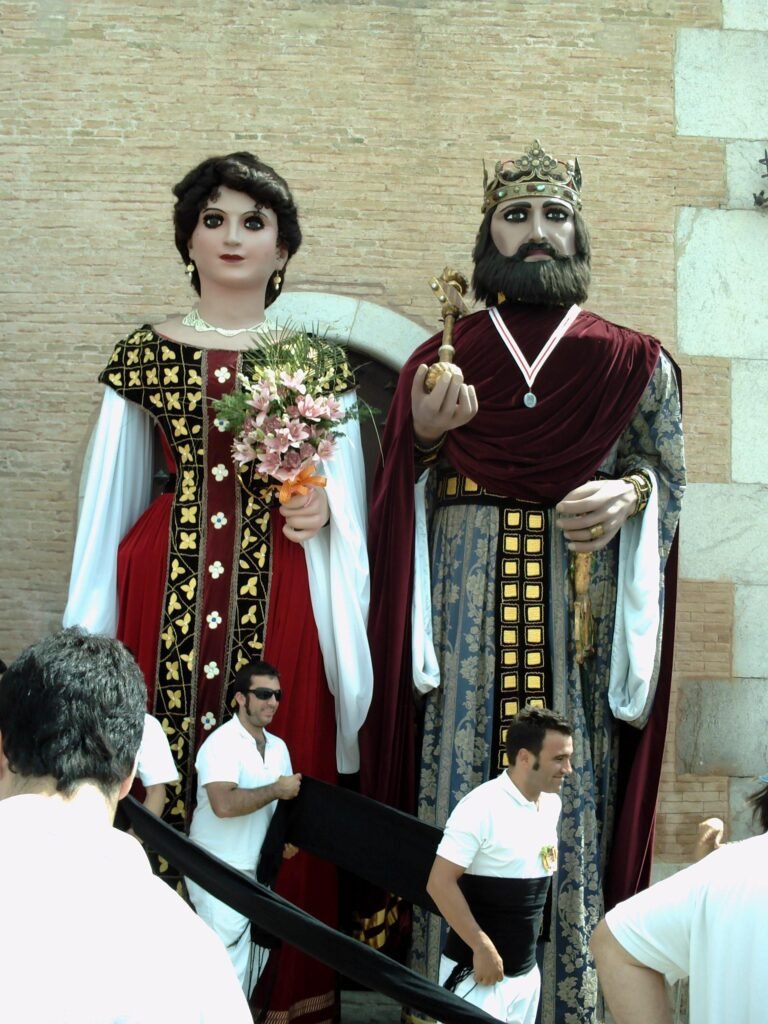

On the afternoon of 23 August, as the Festa Major procession makes its way down Carrer Major towards the Cap de la Vila, Sitges brings out a part of its heritage that is not kept in any museum: giants more than four metres tall, a dragon and an eagle that spit fire, devils who recite verses, and dancers repeating choreographies handed down from one generation to the next. Behind each figure there is a date, a workshop and a group that looks after it. These are the ones recorded in the heritage inventory and municipal documents.
Three pairs of giants
Sitges has three pairs of giants (gegants):
- The Gegants Cristians, or “old giants”. They represent King Jaume I the Conqueror and a lady of his time; he is 4.20 m tall and she 4.10 m. They first appeared at the Festa Major of 1897, built by the Barcelona workshop El Ingenio. In 1902 they won a silver medal for their costumes at Barcelona’s Mercè festivities, and in 1997 the town marked their centenary by naming a street after them.
- The Gegants Moros (Moorish Giants). The originals, known as the giants “d’en Querol”, were made in 1840, commissioned from Joan Querol i Cabanyes, and appeared at Corpus and the Festa Major. Their last known outing was in 1912, at the opening of the Hospital de Sant Joan Baptista. The current pair is a reproduction built in 1978 by Sitges makers linked to the Agrupació de Balls Populars de Sitges and presented in August 1979. They are called La-hia and Fa-luch and are kept at the Palau del Rei Moro.
- The Gegants Cubans or Americanos, also known as Panxito and Panxita. Presented on 22 August 1965, they represent the indianos who came back to Sitges after making their fortune in the Americas: he wears a striped Caribbean-style suit, a straw hat and a Havana cigar; she wears a flowered hat and white gloves. Their story connects with that of the Sitges americanos.
The Drac and the Àliga
The Drac (dragon) made its debut on 23 August 1922, the eve of Sant Bartomeu. It was designed by the Sitges artist Agustí Ferrer Pino. According to the inventory, the first version was rounded, with a cat-like head and a fish tail, and Ferrer, unhappy with it, flattened it into the curved shape it still has. Its body and tail were remodelled in 1975.
The Àliga (eagle) arrived much later, in 1984. It was conceived as a stately dancing figure, but its appearance drew mockery and sparklers were soon fitted to its beak; the following year it was given fire carts (carretilles), and it has been part of the festival’s fire ever since. Both figures, like the Gegants Cristians and the Cubans, are owned by the town council and kept at L’Escorxador.
Devils, Moixiganga and stick dancers
Alongside the figures, the balls populars (traditional dances) complete the procession. The Ball de Diables (devils’ dance) is documented in Sitges from the Festa Major of 1853, though it is probably older. It is one of Catalonia’s spoken dances: Saint Michael and the Angel confront Lucifer, the She-devil and the devils, who recite their versots, now full of irony about local affairs. The text, lost over time, was recovered by the Colla Vella in the 1980s with the help of the weekly L’Eco de Sitges; today it is performed by the Colla Vella and the Colla Jove.
The Moixiganga is an almost static performance of scenes from the Passion, with ten dancers dressed in white and decorated with flowers, accompanied by gralla (shawm) and drum. After the Civil War it nearly disappeared because it was passed on orally, and at one point only one musician knew the tune. The Ball de Bastons (stick dance) is also documented in 1853, and is unusual in being danced by twelve dancers rather than the usual eight or sixteen.
The town’s Festa Major protocol also lists the capgrossos (big-heads) and the Cercolets, Gitanes, Panderetes, Pastorets and Cintes dances, which join the parade of traditional dances.
When to see them
The big occasion is the Festa Major of Sant Bartomeu: on the afternoon of 23 August the parade leaves the town hall square, goes down Carrer Major and ends at the Cap de la Vila, where the Moixiganga performs its complete dance. At the smaller Festa Major of Santa Tecla, on 23 September, children bring out giants, eagles and dragons they have built themselves. The history of the Festa Major explains how this calendar took shape.
None of these figures is fixed in time: they have been rebuilt and reinvented many times. That is why the inventory records are so valuable: they separate verified dates from what festive memory has added along the way.
Sources and further reading
- Els Gegants Cristians and Els Gegants Moros — Inventari del Patrimoni Cultural, Diputació de Barcelona
- Els Gegants Cubans and El Drac i l’Àliga — Inventari del Patrimoni Cultural, Diputació de Barcelona
- Ball de Diables, Ball de la Moixiganga and Ball de Bastons — Inventari del Patrimoni Cultural, Diputació de Barcelona
- Parade of Traditional Popular Dances — Sitges Tourism (Visit Sitges)
- Sitges, l’encant de la tradició (2001) — Ajuntament de Sitges
Keep reading
Traditions and legends
Legends and folk tales of Sitges
The Virgin of El Vinyet, the treasure caves and the sirens of the Garraf coast: the legends of Sitges collected by Joan Amades, told as legends.
Traditions and legends
The history of the Sitges Festa Major
From its first mention in 1353 to heritage festival of national interest: how the Festa Major of Sant Bartomeu in Sitges began and has evolved.
Traditions and legends
The origins and evolution of the Sitges Carnival
From the first recorded dance in 1586 to its return to the streets in 1976: bans, the Retiro and Prado clubs and the history of Sitges Carnival.